WELCOME
CIWW is a regional water production authority established on April 11, 2024. Founded by 12 entities representing utilities, communities and rural providers, CIWW is responsible for drinking water treatment, water system planning, and the wholesale delivery of water across the metro.
Ground-Breaking New Model
The concept of regionalizing water resources has been discussed for decades, not just in Iowa but across the country. During the past decade, efforts to regionalize water ebbed and flowed like a river in the spring with all attempts being abandoned over issues such as governance, representation, costs and models that seem more like centralization than regional cooperation.
In 2020, a group of representatives from Des Moines Water Works, West Des Moines Water Works and the Urbandale Water Utility began meeting to review why past efforts stalled.
Their discussions and subsequent findings led to a ground-breaking new model that retained local control over distribution, customer service and other functions, while regionalizing the supply of drinking water under one authority. After two years of negotiation on the contracts necessary for 12 different water agencies to work together, CIWW was formed and established with the state of Iowa.
CIWW does not replace local water utilities, rural providers or city water departments. They remain the contacts for new accounts, bill-paying and customer service. Find your local provider here.
In the end, cooperation and realization that “we are Stronger Together” carried the day.
“Given the increasing pressure of workforce
issues, regulatory activity and other economic conditions, regionalization and collaboration
within the water service industry is an absolute necessity. It is a necessary step needed to provide
safe water at affordable prices for ratepayers. Congratulations to Central Iowa Water Works.“
TRACY MEHAN
Executive Director of Government Affairs
American Water Works Association
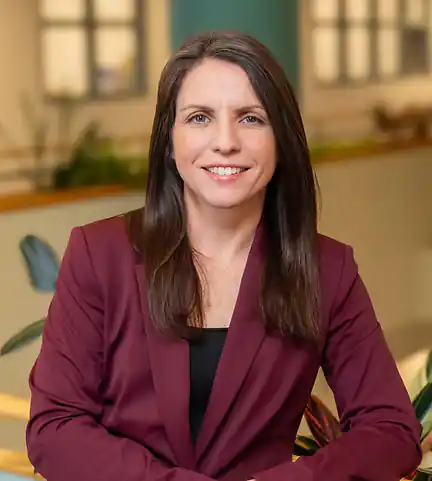
TAMI MADSEN,
EXECUTIVE DIRECTOR
Tami Madsen, who holds a master’s degree in hydrology from the University of Oklahoma and a master’s degree in business administration from the University of Texas in Tyler, is an experienced leader in the water industry. Before assuming the helm of CIWW, she directed a multi-faceted regional utility encompassing drinking water production as well as two waste water plants for industrial use.
“I am proud to lead CIWW in its important work of ensuring safe, affordable drinking water for the entire region for decades to come.”
HISTORY
Central Iowa Water Works grew from decades of discussions about regionalization fueled by the spirit of collaboration among the founders dating back to the 1930s. No regional concept for sharing costs and control of water resources and production gained broad-based support. Discussions restarted with a review of why previous attempts had failed and what needed to change to attain metro-wide support.
1919
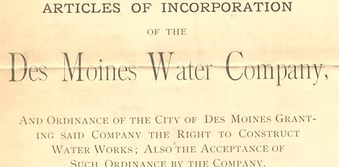
Des Moines Water Works (DMWW) was formed as a public utility under a new section of the Iowa code. The utility had been privately owned since 1871 when it was organized as the Des Moines Water Co. by local businessmen.
1934
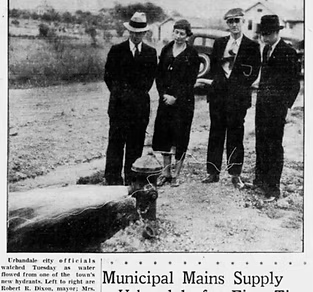
Urbandale signed the first regional agreement with Des Moines Water Works in 1934 for the utility to supply the community its water.
1953
West Des Moines constructed a water treatment plant for removing iron and sediment, disinfecting and filtering water from deep wells.
1974
West Des Moines Water Works (WDMWW) begins to supplement its water production by purchasing water from DMWW.
1993
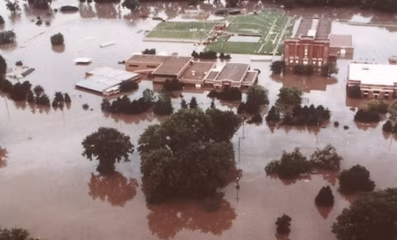
The Great Flood of 1993 inundates DMWW’s Fleur Drive Treatment Plant, leaving much of the region without running water for 19 days. A valiant sandbagging effort staves off flood waters from WDMWW’s plant.
2000
Lessons from the Great Flood and a growing metro water demand led DMWW to the construction of 25-mgd Maffitt Lake Treatment Plant (renamed as L.D. McMullen Treatment Plant in 2007).
2017
Des Moines Water Works, Urbandale Water Utility and West Des Moines Water Works retained FCS Group to gather data, conduct analysis and meet with stakeholders to establish a model for a regional water authority. In October 2018, formation of a regional water utility was proposed, but there was lack of consensus for the model that was suggested.
2019
Des Moines Water Works submitted a new set of terms to regional partners in September based on collaboration and shared risk and costs. The pandemic delayed discussions.
2020
In July, a micro group of DMWW, Urbandale Water Utility and West Des Moines Water Works (the three board-managed utilities) began to meet on a weekly basis to address outstanding questions.
2021
The Micro Group offers a conceptual framework that evolves as regional model. The group shares its Outcomes Report (updated in November). By late 2021, DMWW had signed a founding resolution and WDMWW began a series of public meetings on the issue.
2022
WDMWW and UWA join DMWW with founding resolutions. A draft 28 E/F agreement is released and the new regional model sparks interest from cities and rural water providers.
2023
In late September, a third and final draft of the 28 E agreement is released. A total of 12 entities – including utilities, cities and rural providers – vote to be founding members Central Iowa Water Works.
2024
CIWW becomes a recognized entity and the regional drinking authority for metro.
The 12 Founding Entities
of Central Iowa Water Works